
OpenAI has officially launched its latest programming model, GPT-5.1-Codex-Max, to developers worldwide. This new iteration delivers significant performance enhancements while maintaining the same price point as its predecessor, GPT-5, sparking widespread discussion within the developer community.
The launch of GPT-5.1-Codex-Max represents a strategic move by OpenAI to solidify its position in the competitive AI-assisted programming landscape. By offering superior capabilities without a price increase, the company aims to make advanced AI coding tools more accessible and cost-effective for development teams and individual programmers alike.
Key Features of GPT-5.1-Codex-Max
The standout features of GPT-5.1-Codex-Max are its “agentic” coding capabilities and its exceptional ability to handle ultra-long-running tasks. Leveraging a breakthrough technique called “compaction,” the model can operate effectively within contexts exceeding one million tokens. This substantial context window allows it to manage highly complex, multi-file projects with greater coherence and stability.
Internal testing indicates that GPT-5.1-Codex-Max can maintain consistent performance in extended operations, with sessions lasting over 24 hours. This resilience marks a substantial advancement for AI in programming, enabling the model to assist with lengthy debugging sessions, large-scale refactoring, and the development of complex systems from scratch without degrading in performance.
Read More: OpenAI Launches Lighter GPT-5 Codex Mini
GPT-5.1-Codex-Max Performance
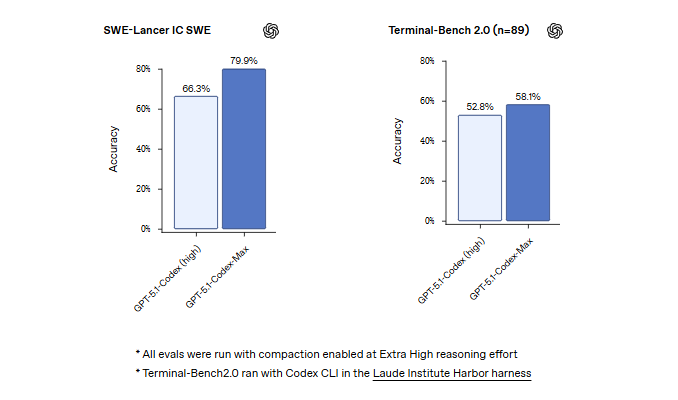
In rigorous benchmark evaluations, GPT-5.1-Codex-Max has demonstrated remarkable proficiency. The model achieved scores of 77.9% on the SWE-Bench Verified test, 79.9% on SWE-Lancer IC SWE, and 58.1% on the challenging TerminalBench2.0. These results indicate a clear and measurable improvement over the standard GPT-5.1-Codex variant.
The performance gains are particularly evident in tasks that require intricate, multi-step reasoning and execution—core components of real-world software engineering. The superior scores suggest that GPT-5.1-Codex-Max is better equipped to understand nuanced requirements, navigate extensive codebases, and generate accurate, executable solutions for sophisticated development challenges.
GPT-5.1-Codex-Max Pricing
In a notable decision for the market, OpenAI has priced GPT-5.1-Codex-Max identically to GPT-5 for API access. The cost is set at $1.25 per million tokens for input and $10 per million tokens for output. This pricing strategy is seen as a direct effort to expand OpenAI’s footprint in the developer tools market and lower the barrier to entry for state-of-the-art AI programming assistance.
A significant shift with GPT-5.1-Codex-Max is its optimization for the Windows development environment. While previous Codex-series models were often tuned with a bias towards Unix-like systems, this new model has been specifically adapted during training to better understand and generate code for the Windows ecosystem. This move strategically targets the vast community of developers who use Windows as their primary platform.
How to Access GPT-5.1-Codex-Max
GPT-5.1-Codex-Max is being rapidly integrated into popular developer tool ecosystems. It is now available through leading programming assistant products such as Cursor, GitHub Copilot, and Linear.
For GitHub Copilot users, access to GPT-5.1-Codex-Max will be provided to subscribers of the Pro, Pro+, Business, and Enterprise tiers. This integration promises to deliver a more powerful and efficient coding experience directly within developers’ existing workflows, offering smarter completions, more accurate code suggestions, and improved handling of complex queries.
Final Thoughts
OpenAI states that this update is fundamentally designed to lower the access barrier to high-performance AI programming capabilities. The goal is to empower a broader range of products and services with programming assistants that are “always ready to write, auto-correct, and execute tasks autonomously.”
The introduction of GPT-5.1-Codex-Max signals a focused push by OpenAI to cater to professional developer needs with a potent combination of enhanced performance, exceptional endurance, and strategic pricing. Its tailored support for Windows and integration into major tools positions it as a compelling option for development teams seeking to boost productivity and tackle more ambitious projects with AI-powered assistance. As the model sees wider adoption, its impact on software development practices and workflows will be closely watched by the industry.